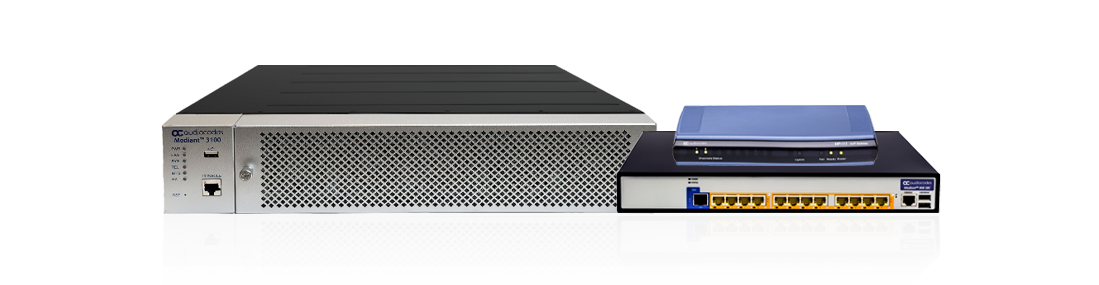
Mediant 3000
The Mediant 3000 is a feature-rich, highly available VoIP gateway supporting low to medium channel densities. The Mediant 3000 compact footprint (2U) meets both the needs of service providers with geographically dispersed networks, as well as those of large enterprises, where reliable and dense VoIP gateways are necessary for business-critical communications.
Mediant 3000 in Service Provider Networks
Service Providers are currently migrating from centralized legacy TDM networks to decentralized IP networks. The Mediant 3000 is aligned with these developments, offering exceptional channel scalability of up to 2016 DSOs in a compact 19”-2U chassis, allowing it to be placed in small POPs, close to local telephone networks. Additionally, the Mediant 3000 delivers the same carrier-grade availability that service providers are accustomed to on their legacy equipment. A wide range of trunking and access protocols to suit any application are provided, such as PRI, V5.2 and CAS access protocols and SS7/M2UA/M3UA trunking protocols. The Mediant 3000 fits the needs of wireline, cable, cellular and mixed service providers.

Mediant 3000 in Large Enterprises
The migration to VoIP in the enterprise is driven by cost considerations and the need for a richer, integrated telephony service. This transition leads to heterogeneous enterprise telephony networks that deploy multiple PBXs from various vendors, some of which are legacy and some of which are IP-based. An enterprise might choose to connect to a PSTN Service Provider or to an Internet Telephony Service Provider (ITSP) or both. The Mediant 3000 has comprehensive PSTN access capabilities as well as SIP to SIP interworking features that enable the interconnection between all these elements. Large enterprises typically deploy business critical contact centers where the high availability of the Mediant 3000 is a key factor. In addition to E1/T1 interfaces, the Mediant 3000 supports high-density PSTN interfaces, such as T3, STM-1 and OC3 to provide the enterprise with lower PSTN lease costs. The proven interoperability of the Mediant 3000 with different PBXs and PSTN switches facilitates smooth deployment.

![]()
| Capacity | Up to 2,016 channels in simplex or redundant configuration |
|
Voice Coders |
High Definition Voice Codecs¹: G.722, G.722.2 (Wideband AMR), G.729.1 (Wideband G.729) Wireline: G.711, G.7221, G.723.1, G.726/7, G.729A/B, EG.711, MS GSM, iLBC1 GSM/UMTS: GSM-FR, GSM EFR, AMR, AMR-WB¹ CDMA: EVRC¹, EVRC-B¹ Independent dynamic vocoder selection per channel (within each group) Not all coders can be used simultaneously |
|
Echo Cancellation |
G.165 and G.168-2002 compliant, with 32, 64 or 128 ms tail length |
| Fax and Modem Transport | Fax/Modem Detection Control, T.38 (IP) compliant Group 3 & SG3 fallback to T.30, fax and modem bypass (automatic fallback to G.711) support |
| DTMF/MF | IP-side or PSTN-side detection and generation, RFC 2833 compliant DTMF relay Detection and Generation of Call Progress tones |
| Quality Enhancement | VAD, CNG, dynamic programmable jitter buffer, 802.1p/Q VLAN tagging, DiffServ |
| PSTN Access | E1 ISDN: EuroISDN, QSIG, Australia, Hong Kong (HKT), Korea, New Zealand, INS-1500 (Japan), VN3, VN4, VN6 (France); T1 ISDN: NI2, 4ESS, 5ESS, DMS100; E1 CAS: MFC-R2 (multiple variants), MELCAS; T1 CAS: E&M, GroundStart, LoopStart; V5.2; IUA |
|
PSTN Trunking |
SS7/Sigtran: M3UA, M2UA, Redundancy (1+1), SS7 Tunneling |
| IP Transport | IETF RFC 3550, RFC 3551 RTP/IP Transport, TCP, UDP, RFC3267, RFC 3558 RTP/UDP/IP, Nb-IP (TS 29.415) |
| Control Protocols | MGCP (RFC 3435), TGCP (PacketCable), MEGACO (H.248, RFC 3015), SIP (RFC 3261) IMS Mn - TS 29.332, IMS Mc (TS 29.232) |
| Security | IPSEC, SIP/TLS, HTTPS, SRTP¹ and AES¹ Separation of OAM, Control and Media traffic is possible by using either different IP interfaces (available only on T1/E1 configuration) or VLANs |
| SIP IP - IP Mediation³ | SIP - SIP Normalization, Network Topology Hiding, Transcoding and Conversion, Signaling Translation, Multiple Service Provider Connectivity and Load Balancing, Redundancy between Servers/Softswitch, Survivability (SAS) 2 |
| Management |
Element Management System, SNMPv2, SNMPv3, CLI, WEB3 |
| Maintainability |
All shelf modules are hot swappable, including boards, power supplies, fans, and power entry modules |
| Redundancy Scheme | Power supply, fans: N+1 load shared Media gateway blades (including PSTN interfaces): 1+1 Optical interfaces (PSTN): 1+1, APS protected |
| Interfaces | PSTN: 1 OC-3 or STM-1 APS optical links, 1 to 3 T3 (DS3) electrical links, up to 63/84 E1/T1 links IP: Dual Redundant 100/1000 Base-T Ethernet ports and additional two Dual Redundant 100 Base-T Ethernet ports for OEM and Control (Available on the E1/T1 configuration only) Clock Synchronization: BITS/SETS (GR-1244 Stratum-3 and G.813 compliant), line synchronization (via STM-1/OC-3 link or DS1 trunk) |
| Enclosure | 4-slot, 2U cPCI chassis |
| Dimensions (HxWxD) | 88 mm x 482.6 mm x 296.8 mm |
| Weight | Approx. 35.27 lbs. (16 kgs.), fully loaded |
| Mounting | Per EIA Standard RS-310-C in 19-inch rack specification |
| Power | 48 V DC Dual Feed, with up to 2 DC Power modules, 100–240 V AC redundant Dual Feed |
| Cooling | Replaceable fan tray & filter |
| Telecommunication Standards | FCC part 68, TBR4 and TBR13 |
| Safety and EMC Standards |
|
| Environmental | NEBS Level 3: GR-63-Core, GR-1089-Core, Type 1 & 3, ETS300 019 |
1 Reduced channel capacity
2 Future release
3 Available on non High Availability configuration
- Low to mid-density VoIP gateway offering scaling from 480 to 2016 channels
- Supports high availability configuration with reliable 1+1 redundancy
- Compact footprint (2U), ideal for small locations
- Allows easy capacity upgrades via a software key
- Provides multi-control protocol support: SIP, H.248, MGCP and TGCP
- Offers broad range of PSTN interfaces including E1, T1, T3, OC3 and STM-1
- Enables flexible interworking between IP - TDM and IP - IP
- Supplies a wide range of vocoders which include Low Bit Rate (LBR), wireline, cellular and wideband vocoders
- No capacity hit on most of the LBR vocoders (e.g., G.729, G.723 and AMR)
- Functions as an IMS Media Gateway and I-BGF network elements
-
Datasheets
-
VoIP media and transcoding gateway
-
-
Brochures
-
Application Notes
-
Military Transition to Next Generation Networks
-
Case Studies
-
Customer Communications solutions with Genesys GVP and AudioCodes Media Gateways
-
Enterprise Migration to Microsoft Unified Communications using AudioCodes Media Gateways
-
A Carrier IP-to-IP Transcoding and Mediation Solution for Unified Messaging
-
Enterprise Aggregation & PSTN Trunking
-
-
White Papers
-
Product Lifecycle Bulletins
-
Product Notice 0081
-
Product notice 0069
-
Product Notice 0060
-
Product Notice 0056
-
Product Notice 0055
-
Product Notice 0050
-
Product Notice 0027
-
-
Compliance and Regulatory Information
-
AudioCodes Policy for Hazardous Substances and WEEE Directives
-
Recycling Passport
-
-
Interoperability Configuration Guides & Scenario Files
-
V2.3
-
By Avaya

