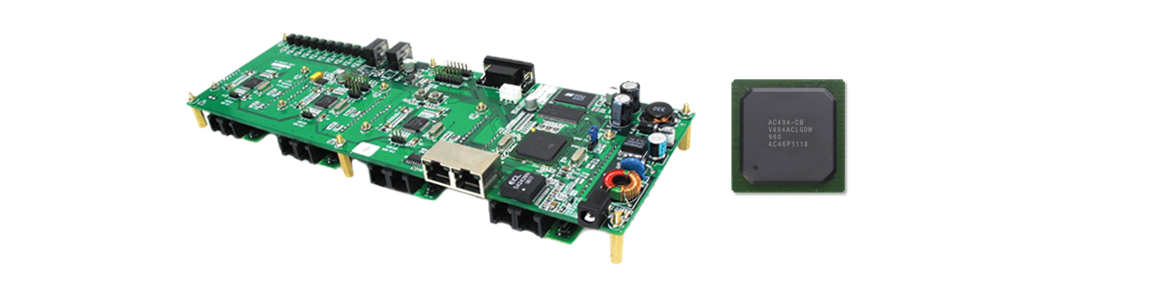
IPM-6310
The IPM-6310 (IPmedia) cPCI VolP Media Processing blade is a highdensity, high-performance VolP media processing blade designed for enhanced voice service applications for both existing and next generation networks. Introducing a comprehensive set of advanced media processing and signaling capabilities on a single cPCI blade, the IPM-6310 is an excellent building block for media services and VoIP application developers targeting better flexibility and short time-to-market.
Deliver Feature-Rich Solutions
A wide selection of firmware-based media processing capabilities is available with the IPM-6310 including: message record/playback, conferencing, onboard announcement storage, IVR streaming and control, voice coding and transcoding, echo cancellation, fax processing and call progress tone detection. Each channel resource on the IPM-6310 is universal and can perform media processing functions independently and simultaneously while utilizing flexibility of endpoints.
Comply With Industry Standards
The IPM-6310 blade complies with industry standard network control protocols including SIP, MEGACO (H.248), MGCP and AudioCodes’ proprietary API – VoPLIB. This allows the implementation of a distributed media server architecture that separates call processing functions from media processing functions. The blade enables scalability, better redundancy and higher system availability.
Protect Customer Investment
The IPM-6310 is based on VoIPerfectTM architecture, AudioCodes’ field-proven, best-of-breed, core media gateway technology for all of its products. The blade supports AudioCodes’ API (VoPLIB) which enables software download, provisioning and control. It was designed to maintain essential API backward compatibility in order to protect customers’ investment in the development of products based on prior generations.
Enable Fast & Easy Integration
Enabling accelerated design cycles with high-density and reduced costs, the IPM-6310 is a foundation for scalable, reliable VoIP enabled media processing solutions. The comprehensive feature set of the IPM-6310 allows customers to quickly design a wide range of solutions combining VoIP and PSTN networks.
IPM-6310 Features
- Up to 2016 universal media processing ports
- Comprehensive IVR control
- Real-time, multi-party conferencing with mixed IP/PSTN/H.110 endpoints
- High density Voice Record/Playback over the network
- Real time Fax over IP/T.38
- Voice transcoding between wireline and wireless networks
- VoIP packet streaming (RTP/RTCP) per RFC 3550/3551
- SIP, MEGACO, MGCP and AudioCodes’ proprietary API (VoPLIB)
- CPSB PICMG 2.16 compliant Ethernet on the backplane
- Optional STM-1/OC-3 or 3 x T3 PSTN interfaces
| Voice Messaging, Recording | Record/play using standard NFS streaming – 2016 channels1 On-board announcement storage – 32 MB: 60 min of G.711 RTP forking replications for lawful intercept (CALEA) |
| N-way Conferencing | Supports up to 2016 ports of Mixed IP, PSTN and TDM (H.110) participants Maximum full-duplex parties per conference bridge: 64 endpoints Up to 3 simultaneous active participants or linear summation mode (all active) Supports various conference control modes |
| Fax Relay and Termination | Real-time fax over IP/T.38 compliant, automatic fallback to G.711 and VBD for up to SG-3 Concurrent fax sessions on all the channels Support for Fax Termination (Available with AudioCodes S/W based stack) |
| ASR2 | Distributed Architecture – Media Stream over VoIP RTP |
| Voice Compression | Supports up to 2016 ports of: G.711, G.723.1, G.729A/B, G.726, G.727, GSM-FR, GSM-EFR, EVRC, NB-AMR, iLBC Wide Band coders including G.722 and AMR Additional coders supported2 |
| Voice Processing | Voice Activity Detection (VAD) and CNG Transcoding of LBR to LBR coder supporting 1024 channels Transcoding of G.711 RTP to any LBR coder supporting 2048 channels1 |
| Echo Cancellation | G.168 with tail of 32 msec, 64 msec and 128 msec |
| Gain Control | Automatic (AGC) or Programmable |
| In-band/Out-band Signaling | Packet side or PSTN side, DTMF and tone detection and generation, RFC 2833 |
| Control Protocol | AudioCodes’ proprietary API - VoPLIB, SIP, MEGACO (H.248), MGCP (RFC 3435, RFC 3660) |
| Management |
|
| Operating System | - Windows™ 2000, XP, 2003 - Linux™ 3 RH8, RH9, Debian, Enterprise - Solaris™ 3 8,9 on Intel™/Sparc™ 32/64 |
| PSTN | CAS T1 robbed bit, MFC/R2 numerous country variants CCS ISDN PRI: numerous country variants including ETSI EURO ISDN, ANSI NI2, DMS, 5ESS, Japan INS1500 SS7 MTP2 and MTP3 link termination |
| SIGTRAN | M2UA, M3UA, IUA and DUA over SCTP per RFC 2960 |
| Form Factor | 6U PICMG 2.16 compliant, single cPCI slot, full Hot Swap |
| Interfaces | Dual GBEth, TDM: H.110, PSTN: OC-3/STM-1 APS protected or 3 x T31 |
| Power | 40-85 W2 |
1 Future Release
2 Consult AudioCodes for specific configuration
3 See release note for specific OS releases supported
- Provides high-density, high-performance blade for carrier grade VoIP applications
- Enhanced IP-enabled media service features
- Embodies rich and comprehensive API (VoPLIB)
- Implements field-proven and cost-effective technology
- Enables scalable distributed architecture
- Reduces development cycle
-
Datasheets
-
cPCI VoIP Media Processing Blade
-
-
Brochures
-
Application Notes
-
White Papers
-
Product Lifecycle Bulletins
-
Product Notice 0081
-
Product notice 0069
-
Product Notice 0060
-
Product Notice 0056
-
Product Notice 0055
-
Product Notice 0050
-
Product Notice 0037
-
Product Notice 0027
-
-
Compliance and Regulatory Information
-
AudioCodes Policy for Hazardous Substances and WEEE Directives
-
Recycling Passport
-