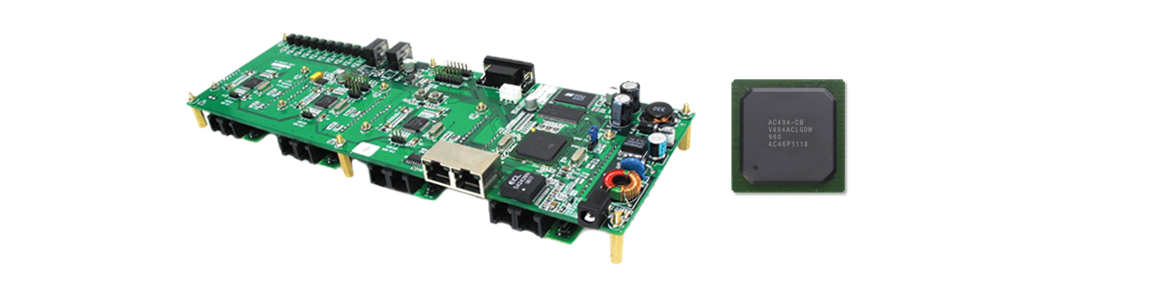
TP-260 - 8 E1/T1 PCI VoIP Communication Blade
The TP-260 PCI VoIP communication blade, based on AudioCodes’ TPM-1100 PMC Modules, is an ideal solution for trunking gateways to the PSTN and integrated gateways for IP-PBXs and all-in-one communication servers. The TP-260 provides 256 ports for voice, fax or data implementing VoIP media gateway applications.
Deliver Feature-Rich Solutions
The TP-260 supports a broad selection of voice processing related algorithms, including G.711, G.723.1 and G.729AB Vocoders, G.168-compliant echo cancellation, T.38 Real-time Fax over IP, as well as a wide selection of In-band and Out-band tone detection and generation. The TP-260 wide selection of TDM interfaces allows easy integration with other third party CTI blades. The E1/T1/J1 PSTN interface and wide range of supported telephony protocols provides TP-260 users a higher level of integration, saving backplane slot space, enabling higher density gateway platforms while reducing the costs per channel.
Comply with Industry Standards
The TP-260 blade complies with industry standard network control protocols including MGCP, MEGACO (H.248) as well as AudioCodes’ proprietary TPNCP. These allow for the implementation of a distributed gateway architecture that separates call-processing functions from media streaming functions, resulting in better redundancy, scalability and higher system availability.
Protect Customer Investment
The TP-260 is based on the VoIPerfectTM architecture, AudioCodes’ underlying, best-of-breed, core media gateway technology for all of its products. The TP-260 supports AudioCodes’ API, which enables software download, provisioning and control. It was designed to maintain essential API backward compatibility in order to protect customers’ investment in the development of products based on former generations.
Enable Fast & Easy Integration
Enabling accelerated design cycles with low to high density and reduced costs, the TP-260 is an ideal building block for scalable, reliable VoIP solutions. With the TP-260’s comprehensive feature set, customers can quickly design a wide range of solutions for smooth migration to VoIP networks.
TP-260 Features
- 256 independent voice/fax/data ports
- VoIP packet streaming (RTP/RTCP)
- Standard control: MGCP (RFC 2705), MEGACO (H.248)
- Real-time Fax over IP/T.38
- On-board announcement support towards PSTN/TDM and IP
- Tone detection and generation (MF, DTMF, RFC 2833)
- PSTN signaling: CAS, ISDN PRI, and SS7
- SIGTRAN IUA, M2UA, M3UA over SCTP
- Media Gateway on a blade mode
- MVIP SCbus and H.100 TDM interfaces
- Management interfaces: SNMP, Web server
- On-board 10/100Base-T Network interface
- Optional universal PCI version
| Capacity | 32, 64, 128, 248 independent digital voice, fax and data ports |
| Voice Compression | G.711, G.723.1, G.729A/B, G.726/G.727, NetCoder® MS-GSM, GSM-FR, iLBC Additional coders supported – contact AudioCodes for further information |
| Echo Cancellation | G.168 compliant 32, 64 msec echo tail 128 msec tail available with reduced channel capacity |
| Fax Relay and Termination | Real-time fax over IP/T.38 compliant, automatic fallback to G.711 and VBD for up to super G-3 fax machines Support for Fax Termination (Available with AudioCodes S/W based stack) |
| ASR-3rd party | Host-based architecture – media system PCI |
| Recognition Engines | Distributed Architecture - Media Stream over VoIP RTP |
| In-band/Out-band Signaling | Packet side or PSTN side, DTMF and tone detection and generation, CAS Relay, RFC 2883 |
| IVR Support | On-board announcement storage – 10 Mb: 20 minutes of G.711, 200 minutes of G.723 |
| VoIP Standards Compliance | RTP/RTCP per RFC 3550/3551 DTMF over RTP per RFC 2833 |
| Control Protocols | Media Gateway on a blade mode: Controlled by either MGCP or MEGACO PCI used for power only AudioCodes’ proprietary VoIP API Library over IP (TPNCP) or PCI |
| Management Interfaces | SNMP V2c: Standard MIB-2: system, interfaces, if-MIB, entity-MIB, RTP-MIB, DS1-MIB, snmpV2-MIB and AudioCodes’ proprietary MIB On-board embedded secure Web Server |
| Operating System | Windows™ 2000, XP, 2003 Linux™1 RH8, RH9, Debian, Enterprise Solaris™1 8,9 on Intel™/Sparc™ 32/64 |
| PSTN | CAS T1 robbed bit, MFC/R2 numerous country variants CCS ISDN PRI: numerous country variants including ETSI EURO ISDN, ANSI NI2, DMS, 5ESS, Japan INS1500 SS7 MTP2 and MTP3 link termination, SS7 monitoring ISUP and SCCP/TCAP termination (Available with AudioCodes S/W based stack) |
| SIGTRAN | M2UA, M3UA, IUA and DUA over SCTP per RFC 2960 |
| Ethernet | 10/100 BASE-T |
| Physical Interfaces | Form factor - Full length PCI blade TDM Interfaces - MVIP, SCbus or H.100 Telephony –120 Ohm — RJ48C connectors Ethernet – RJ-45 Universal PCI 5 V/3.3 V signaling PCI bus –32/64 bit, 33/66 MHz |
| Power | 3.6A at 5V with quad E1/T1 interface |
1 See Release note for specific OS releases supported
- Complete media gateway on a module
- Low to high channel density
- Concurrent toll quality voice and fax support
- Media gateway on a blade mode
- Wide range of PSTN signaling protocols
- Fast time-to-market
- Flexible and easy migration to VoIP networks
- Extensive VoIP experience
-
Datasheets
-
8 E1/T1 PCI VoIP Communication Blade
-
-
White Papers
-
Product Lifecycle Bulletins
-
EoS for SW Version 5.2
-
Product Notice 0081
-
Product notice 0069
-
Product Notice 0060
-
Product Notice 0055
-
Product Notice 0052
-
Product Notice 0050
-
Product Notice 0034
-
Product Notice 0044
-
Product Notice 0037
-
Product Notice 0027
-
End of Life Announcement TP-260A, IPM-260A and ATP-260A (non-universal)
(PDF, 147.0KB)
Release Date: Jul 25, 05Product Notice 0024 -
Product Notice 0009
-
-
Documentation
-
Compliance and Regulatory Information
-
Regulatory Information
-
AudioCodes Policy for Hazardous Substances and WEEE Directives
-